
Once our team felt that we had a solid understanding of our target demographic and current products that exist in this space, we began brainstorming possible design directions we could take with the project.
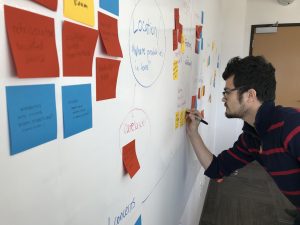

In our brainstorming session, one of the major things we discussed was where the product would live in the user’s home. We were initially interested in the product moving autonomously, giving it the ability to exist in multiple locations in the home at different times, but later on we determined that this concept posed a great trip and/or fall risk. We talked about the kitchen and living room being two major areas in which the target demographic spent a lot of their time at home, based on the user interviews we conducted.
We also thought about how this product may benefit from integrating with existing technology products (e.g. smart watches) that can measure the user’s heart rate, sleep, and other health metrics. We intentionally avoided adding that functionality directly to Bridge to keep the cost of the product low.
There were many categories of features we initially wanted to integrate into Bridge’s graphical user interface. The five main modules we were interested in developing were:
- Mental health tracking
- Physical health tracking
- Daily routine & Scheduling
- Emergency & Locating
- General/Miscellaneous (Notepad, photo album, etc.)
Based on the analysis of our collected data, we identified distinctive user needs and mapped these into product requirements to keep in mind as we began ideating potential forms that the product may take:

We began to produce sketches to identify potential hardware design directions we could take. Each of the design directions features a visual and voice interface to allow the user to engage with the smart assistant.

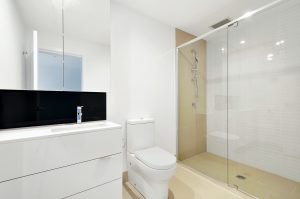
Here is a concept for a bathroom mirror cabinet enhanced with a display to provide information seamlessly to the user when they need it during morning and night time personal routines.
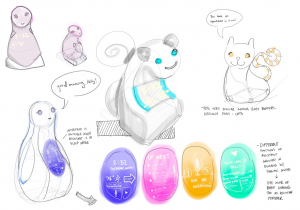
Another design direction we explored was a series of friendly home robots to reduce the sense of social isolation and to have the ability to autonomously navigate to where the user is located in the home.
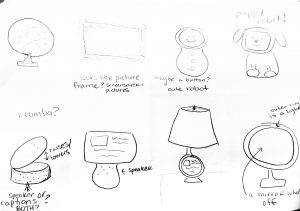
We also explored the idea of more subtle integrations of the smart assistant into products that most users in our target demographic already have in the home, such as lamps, clocks, and photo frames.

Once we came up with these potential product ideas, we ran a mini virtual focus group with users in our target demographic to help us decide which design to move forward with.
When we described the idea of a smart mirror and medicine cabinet, the participants were concerned about the privacy risks of putting a smart device in the bathroom. One participant also mentioned that she does not spend much time in the bathroom and would not see herself rushing to there to ask the mirror a question.
We also presented the pet-like robot concepts. A participant mentioned a friend that had something similar, but thought that this type of product would be better for companionship and not necessarily health and “connectedness” to other people. They also echoed our concern that this could potentially be a tripping hazard if it is moving around on the floor.
Another design direction we presented was the integration into a clock, but they mentioned that they prefer to use digital clocks rather than analog clocks since they are easier to read. They did not see the need for an additional clock because they already had clocks on their phones, computers, TVs, and kitchen appliances. They did, however, see the value in integrating our system into something that is already commonly found in homes, but thought that something else might be more effective.
One participant was especially excited about the idea of a smart whiteboard inspired by our smart mirror idea and the whiteboard at his brother’s retirement facility. Another participant mentioned the idea of a rotating picture frame that one of her friends had, but brought up that people put pictures in the living room and that is not necessarily where they would go to ask if they took their medication. When we asked them where in the home they would most like to have a health device, they said the kitchen since this is where they typically spend the most time and where they keep their medications.

Upon further discussing having a device like this in their kitchen, they mentioned how they put photos, notes, and shopping lists onto their refrigerator and were excited about the idea of a digital “information center” inspired by the content on their refrigerator.
Based on the insights gained during our focus group, we decided to move forward with an information center designed for the kitchen.